
The “Number”: How Much Money Do I Need?
Excerpt adapted from the Book:
The Aspirational Investor by Ashvin B. Chhabra
Rather than following a disciplined retirement savings strategy, many people rely on their gut and make intuitive estimates of a single, aspirational number that reflects the amount of money they think they need in the bank to enjoy retirement bliss. This is often referred to as “the Number”—the minimum required net worth that would enable you to say to the world: “That’s it. I’m done!”
So what’s your Number? Think about it for a minute. Was it always the same—or has it changed over the years? Or is there no number that would move you to retire because you always want to be working in one capacity or another?
It turns out that the more money you are worth today, the more you probably feel you need to accumulate further before calling it quits. Consider the goal of becoming a millionaire, a popular and still attainable goal for Americans living at the median US wealth level of $125,000 and who still have plenty of working years ahead of them. When upwardly mobile middle-class Americans move into the ranks of millionaires, rather than celebrating, many are more likely to focus on the fact that $1 million is not what it used to be and may not be nearly enough to sustain their lifestyle in retirement. Indeed, in the United States alone there are roughly 3 million millionaires these days, so they are not exactly a rarity.
Once these Americans accumulate a net worth of $2 million to $3 million, they begin to enjoy some sense of financial security and success—but soon realize that $5 million is the true inflection point between merely affluent and wealthy. Those with $5 million want $10 million. Those with $10 million think $25 million or even $50 million would do the trick. And so it goes all the way up to the Forbes 400, where $1 billion is simply the cover charge. The irony is that, along the way, everyone who is not in financial distress recognizes full well—or claims to recognize—that they are not in it for the money.
Lee Eisenberg, a former editor of Esquire magazine, captured this constant resetting of expectations in a provocative 2006 book called The Number. The inspiration for Eisenberg’s book, which, appropriately enough, featured a nest egg on its cover, was the author’s own struggle to understand exactly how much money he needed to sustain himself and his wife in retirement. The process of answering this seemingly simple numerical question led him to much deeper questions about what kind of life he wanted to lead, in the present and in the future.
Eisenberg captured many interesting aspects of how people think about money and how interconnected money has become with almost every aspect of our lives. Most interesting and telling of all, perhaps, is his conversation with an anonymous Wall Street type whom Eisenberg calls “Deep Pockets.” When Eisenberg asks him to explain how he thinks the Number “works its will” among the relatively well-off people he knows, Deep Pockets describes four types of lifestyles: “Comfortable, Comfortable Plus, Kind of Rich, and Rich.”
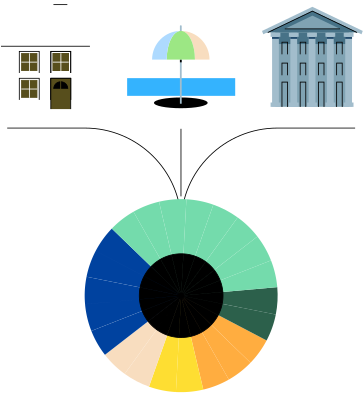
The Four Wealth Archetypes, According to “Deep Pockets”
Comfortable
A modest but enjoyable lifestyle—living in one place, eating well, and traveling occasionally but not extravagantly. To maintain this, you’ll need $50,000 to $100,000 in annual spending, which translates to a net worth of $1 million to $2 million.
Comfortable +
A step up in lifestyle—membership at a country club, a second home, and an upgraded standard of living. This requires $175,000 to $200,000 in annual spending and a net worth between $2 million and $5 million.
Kind of rich
Multiple homes, charitable giving, and the ability to enjoy life’s finer things—luxury travel, high-end experiences, and financial generosity. Maintaining this lifestyle means spending $350,000 to $500,000 per year and having a net worth of $7 million to $10 million.
Rich +
The ultra-wealthy—owning properties in multiple locations, traveling by private jet, and holding influential board seats. Living at this level requires at least $1 million per year in spending and a net worth exceeding $20 million.
Eisenberg does not describe the underlying assumptions behind Deep Pockets’s rough calculation, though the number specified is about twenty times the expected annual spending. Indeed, almost every financial firm has a detailed retirement calculator that will provide you with an estimate of what you need to retire. The problem is that to arrive at your Number, either they or you must quantify several key inputs that in most cases are simply educated guesses. Some are estimates of your life expectancy, current income, and anticipated retirement age, as well as future inflation, tax rates, and stock returns. Based on the assumptions used by the calculator, and by adjusting the variables, notably the estimated rate of return of your portfolio, you can, frankly, arrive at almost any Number.
A parting thought...
As you go through life, your goals will continue to evolve. In some cases, such as the Number you desire for retirement may be an ever-moving target. The lesson here is: in a purposeful, well-lived life, the journey toward achieving your goals is just as meaningful as reaching them.